MONEY
Margin, shorts, options & bonds
Borrowing to invest, short selling and lending shares, calls and puts, the bond market, and why you would use each.
What they are for
Buying shares is a bet that a company will do well. The rest of the market lets you act on any view: that an airline is overvalued and will fall, that its price will stay put, that its credit will improve, or that you want to protect a stake you already hold. Every action in the game explains itself: hover over a button (or press and hold on a phone) to see what it does, why you would do it and what to watch.
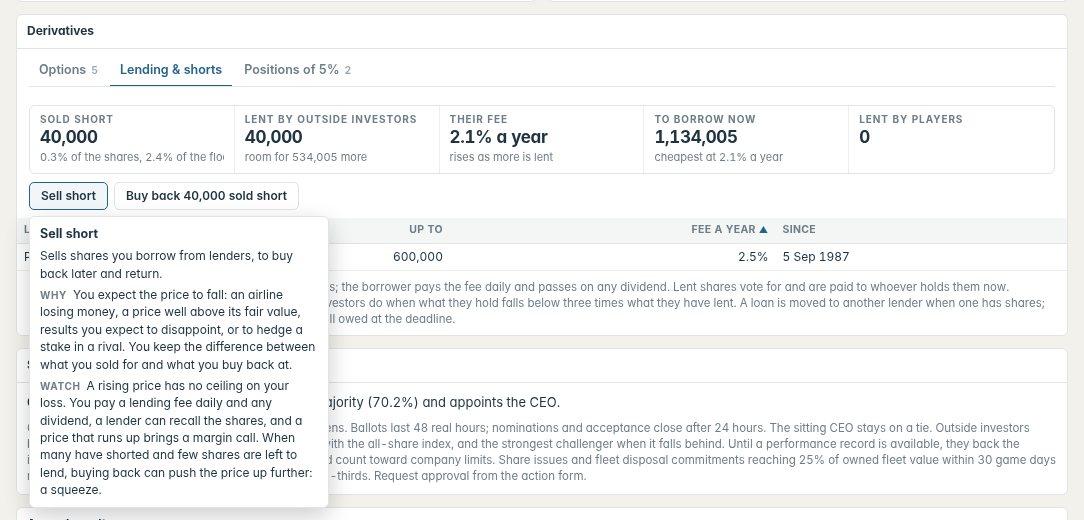
| You think | You could |
|---|---|
| A company will rise | buy shares, buy on margin for more, or buy calls |
| A company will fall | sell its shares short, or buy puts |
| A company's price will stay flat | write calls on shares you hold, or write puts |
| You want to protect a stake | buy puts on it |
| An airline's credit will improve | buy its bonds |
| An airline's credit will worsen | sell its bonds short |
| You hold shares or bonds for the long run | lend them for a fee |
The margin account
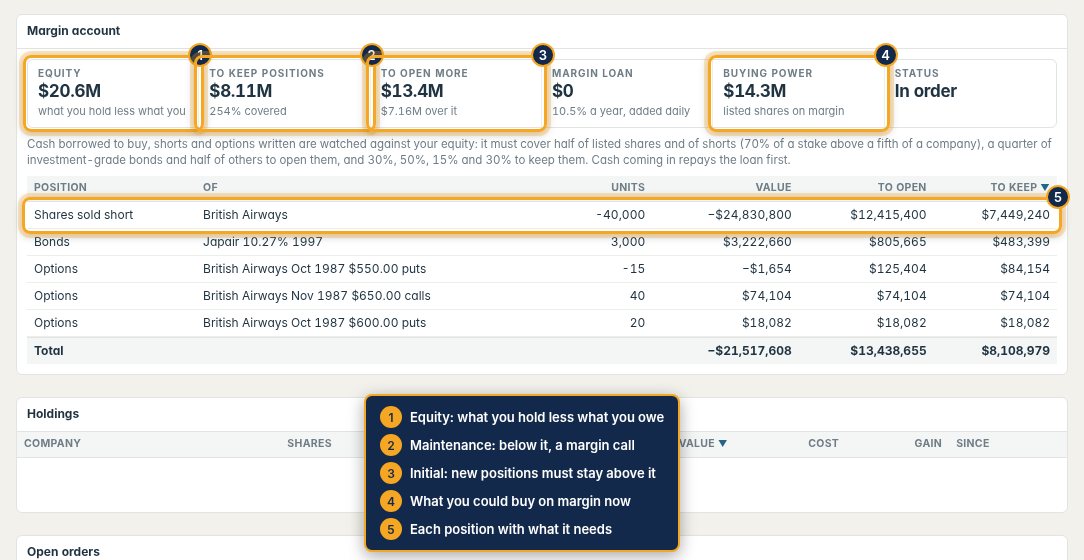
Your personal capital is a margin account. Its equity is your cash and everything you hold at market prices, less the margin loan and what it would cost to buy back shorts and options you wrote. Each position needs some of that equity: more to open it (the initial requirement) and less to keep it (maintenance).
| Position | To open | To keep |
|---|---|---|
| Listed shares, and shares sold short | 50% | 30% |
| A stake above a fifth of a company | 70% | 50% |
| Investment-grade bonds (BBB- or better) | 25% | 15% |
| Other bonds | 50% | 30% |
| Options bought, and unlisted shares | all | all |
| An option written that your shares do not cover | its value plus 1.5 times the greater of 20% of the share price less what it is out of the money, and 10% of the share price (of the strike for a put) | its value plus that greater amount |
Choose On margin when you buy shares, bonds or options, make a takeover offer or invest in your own airline, and the account lends what your capital does not cover, at the base rate plus 2% a year, added daily. Any cash that comes in repays the loan first. Buying power is what you could buy on margin now. Without a loan, shorts or options written, nothing here can go wrong: equity always covers what you hold.
If equity falls below what your positions need to keep them, you get a margin call: add capital, close positions or wait for cash coming in. Below two-thirds of it, the game closes positions at the market until it is covered again: shorts and options written first, then options and bonds you hold, then your smallest stakes, and stakes that control a company last. Borrowing against your own airline's shares can buy you a rival, but a fall in your own price can then force a sale of them.
Selling short
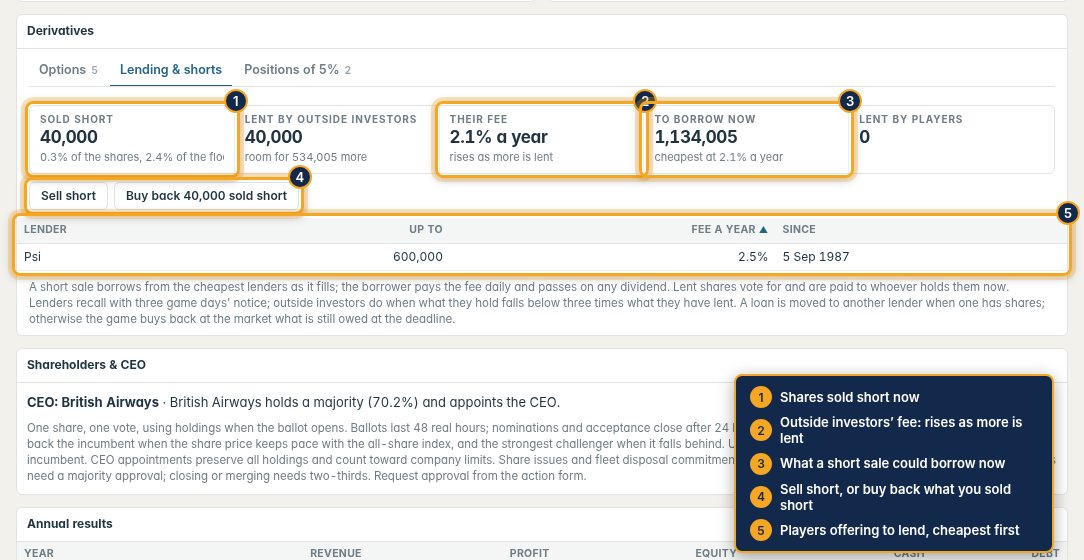
A short sale sells shares you borrow, to buy back later and return. If the price falls, you buy them back for less and keep the difference; if it rises, you lose, with no ceiling. Sell short is on a company's share page under Derivatives → Lending & shorts, which shows how many shares are sold short, what outside investors charge to lend, and how many can be borrowed now.
The sale borrows from the cheapest lenders as it fills. Outside investors lend up to a third of what they hold, at 2% a year rising to 25% as more of it is out; players lend at fees they set. While the short is open you pay the fee daily, and any dividend the company pays goes to the lender from you. Your margin account must hold half the shares' value to open the short and 30% to keep it, so a price that runs up brings a margin call.
A lender can recall the shares with three game days' notice; outside investors do when what they hold falls below three times what they have lent, as when players buy up the float or a takeover is accepted. The game first moves your loan to another lender who has shares; if none has, buy them back by the deadline or the game buys them for you at the market. When many have sold short and few shares are left to lend, buying back pushes the price up and forces more buying: a squeeze. Buy back closes the short, returning the shares to their lenders, recalled loans first, then the dearest.
If the company closes or merges away, every short settles at what each share is paid.
Lending your shares
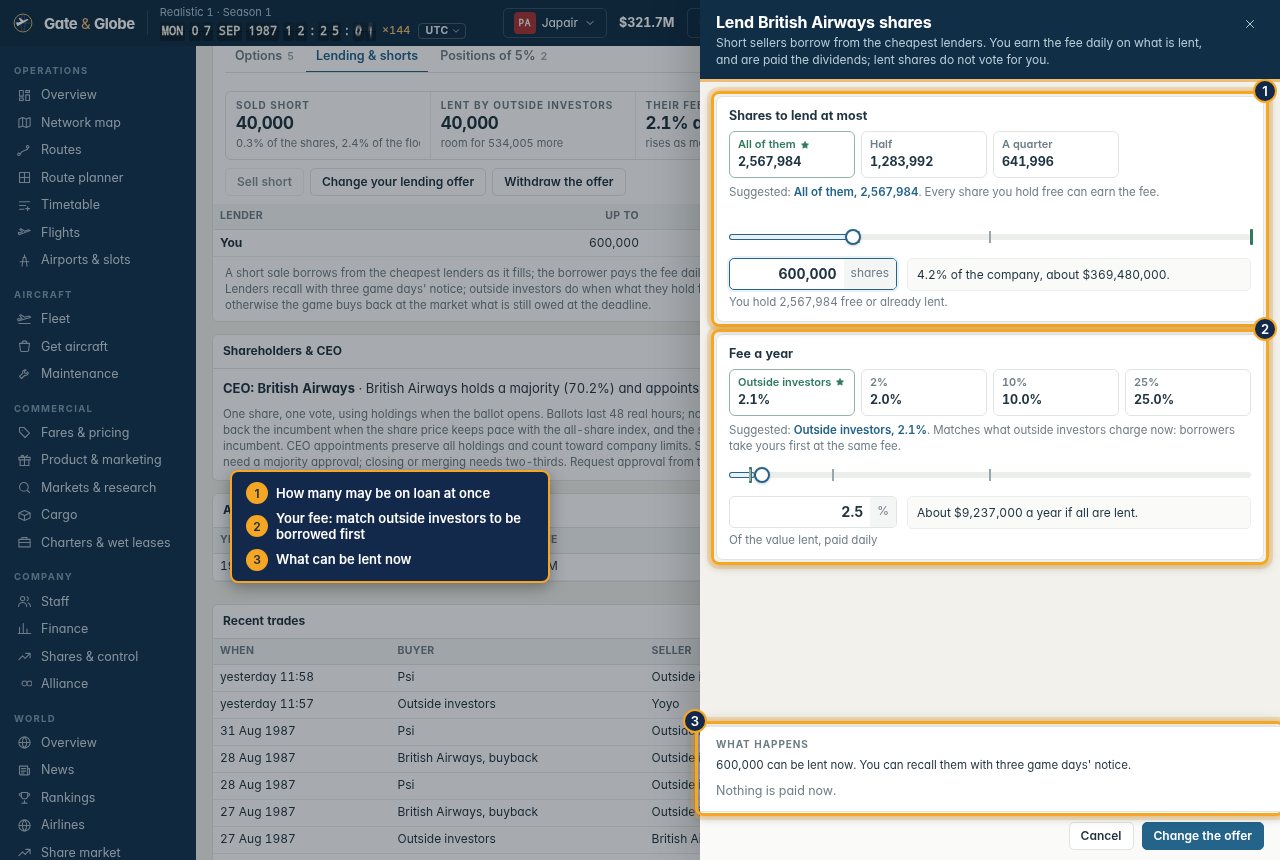
Lend your shares offers shares you hold to short sellers for a yearly fee you set, paid to you daily on what is lent. You are still paid the dividends. Match outside investors' fee to be borrowed first, or set it higher to lend only once theirs run out, as in a squeeze. Lent shares vote for whoever holds them now, not you, and to sell them you recall them first. A controller cannot lend below the shares that give control. Recalling when few shares are left to lend can force short sellers to buy back.
Options
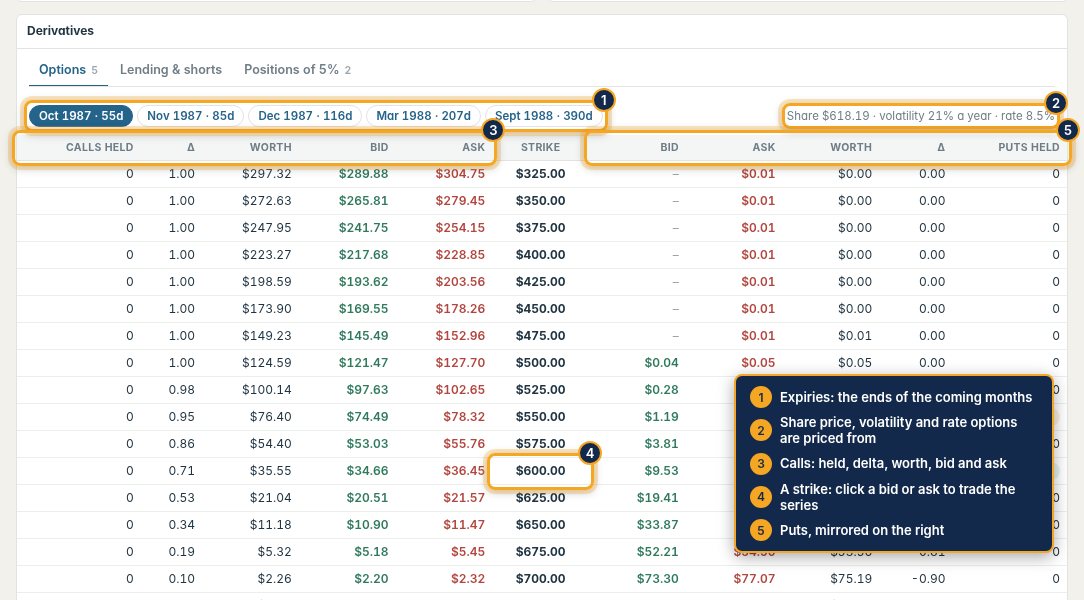
Each listed company with a share price of $1 or more has calls and puts on its shares, under Derivatives → Options. A contract is 100 shares. Series expire at the ends of the coming 1, 2, 3, 6 and 12 months, at strikes from half to one and a half times the share price. The chain shows each expiry's strikes with calls on the left and puts on the right: contracts held, delta (how much the option moves for each $1 on the share), what it is worth a share, and the bid and ask.
- A call is the right to buy at the strike. Buy calls to bet on a rise for a fraction of what the shares cost; the most you can lose is what you paid.
- A put is the right to sell at the strike. Buy puts to insure shares you hold against a fall, or to bet on a fall with a limited loss.
- Writing an option sells it: you are paid now and take on the other side. Writing calls on shares you hold earns income while you expect the price to stand still, giving up any rise above the strike; the calls are covered by your shares, which are held until the calls expire or are bought back. Writing puts earns income while you expect the price to hold up. Options written beyond your shares need equity in the margin account and can lose far more than you were paid.
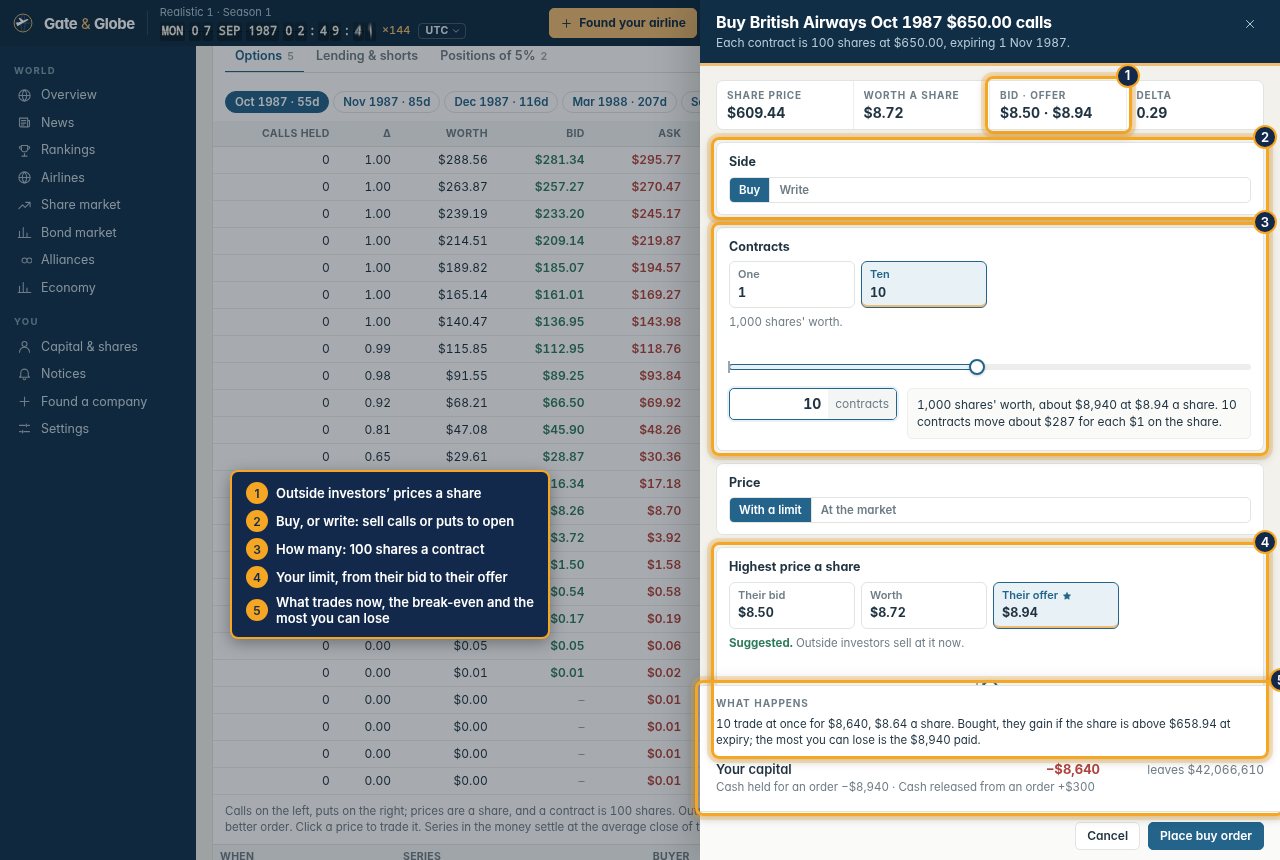
Click a bid or ask to trade that series. Each series has its own order book: players buy and write at prices a share, and outside investors make a market in every series around what it is worth, from the share's moves over the last 90 game days and the base rate, 5% apart. Their prices rise as they sell and fall as they buy, and they hedge what they hold by trading the shares, so heavy buying of calls lifts the share price and heavy buying of puts pushes it down. Their own trading also meets players' orders standing between their prices.
At expiry, a series in the money settles at the average close of the last five game days. Holders are paid the difference in cash, or take delivery at the strike if they chose Take delivery and have the cash (calls) or the shares (puts). Covered calls deliver the writer's shares at the strike; other writers pay the difference. Out of the money, every contract lapses: buyers lose what they paid and writers keep it.
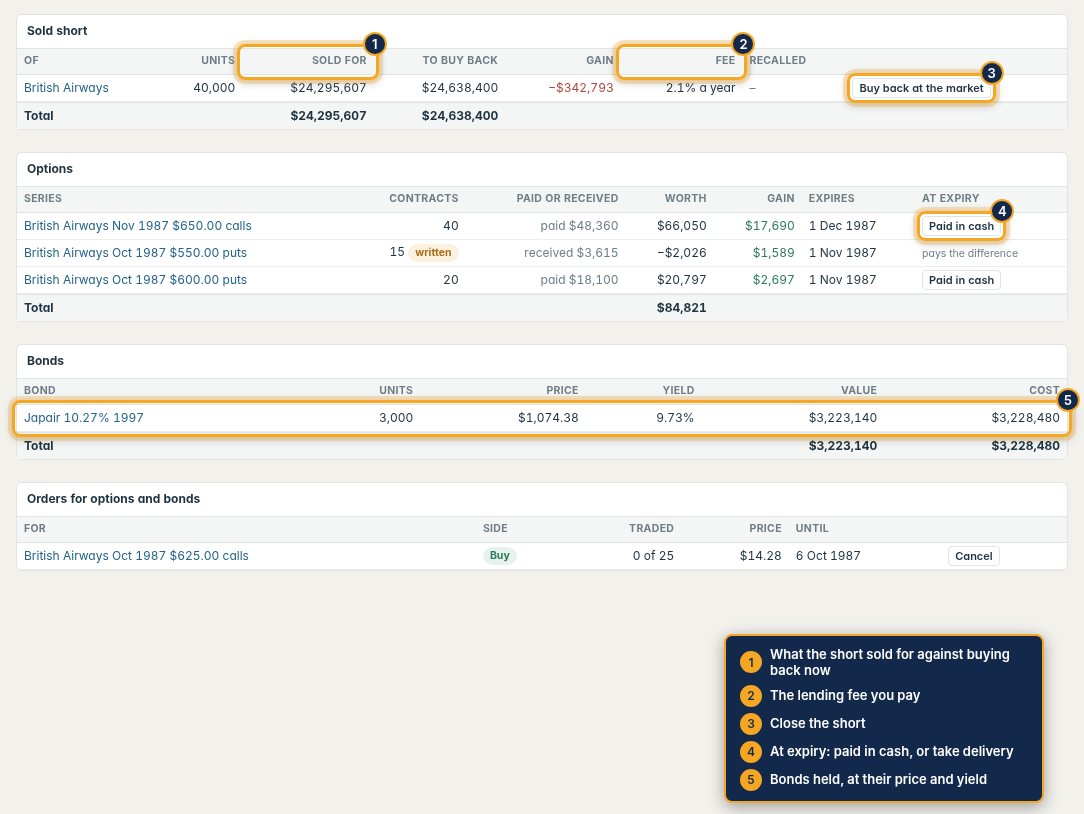
Your shorts, options, bonds and orders are listed on Capital & shares, with what each is worth and what it has gained.
Insiders and disclosure
A company's controller or CEO and anyone holding 10% of it must stay net long in it: they may not sell its shares or bonds short, and the puts they hold and calls they write may cover no more shares than they hold or have lent. Owners can protect a stake or earn on it, but cannot gain from running their airline into the ground. Anyone who becomes an insider has seven game days to close what breaks the rule before the game does, and insiders' option trades and lending in their own airline are reported in the news.
Positions of 5% on each share page lists every player whose shares held and lent, shorts and options (at 100 shares a contract) come to 5% of the company: who is building a stake, who is betting against it, and who could swing a vote.
The bond market
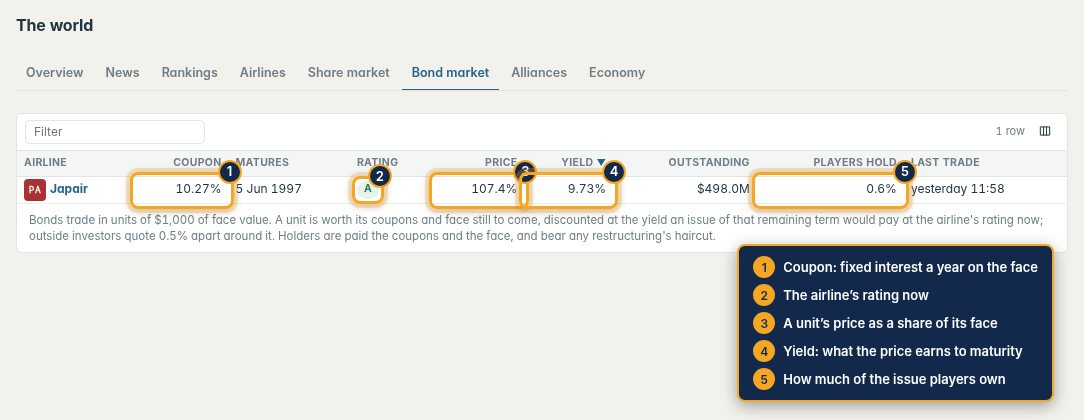
When an airline issues bonds (under Finance → Loans & bonds), outside investors buy them, and from then on they trade. The world → Bond market lists every bond: its coupon, maturity, the airline's rating now, its price as a share of face value, its yield and how much players hold.
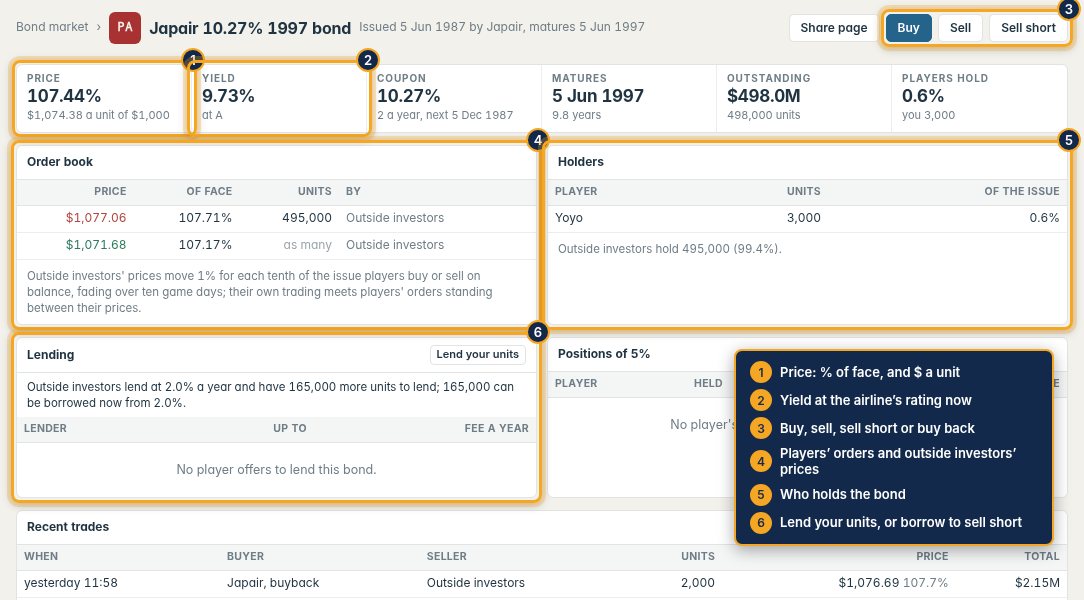
Bonds trade in units of $1,000 of face value. A unit is worth the coupons and face still to come, discounted at the yield an issue of that remaining term would pay at the airline's rating now, so its price rises when the rating improves or rates fall and drops when they go the other way. Outside investors quote 0.5% apart around it, their prices moving 1% for each tenth of the issue players buy or sell on balance, fading over ten game days.
- Buy to be paid the coupons and the face at maturity: steady income, paid before shareholders if the airline fails. Bonds bought on margin need a quarter of their value covered if the airline is investment grade, half otherwise.
- Sell to take the price now.
- Sell short if you expect the airline's credit to worsen. You pay the lender the coupons and a fee, as with shares.
- Lend your units for a fee while you hold them.
Holders are paid each coupon, the face at maturity or when the airline redeems early, and, if the airline is liquidated, what its liquidation recovers. A restructuring's haircut and deferral fall on the holders.
Your airline's bonds
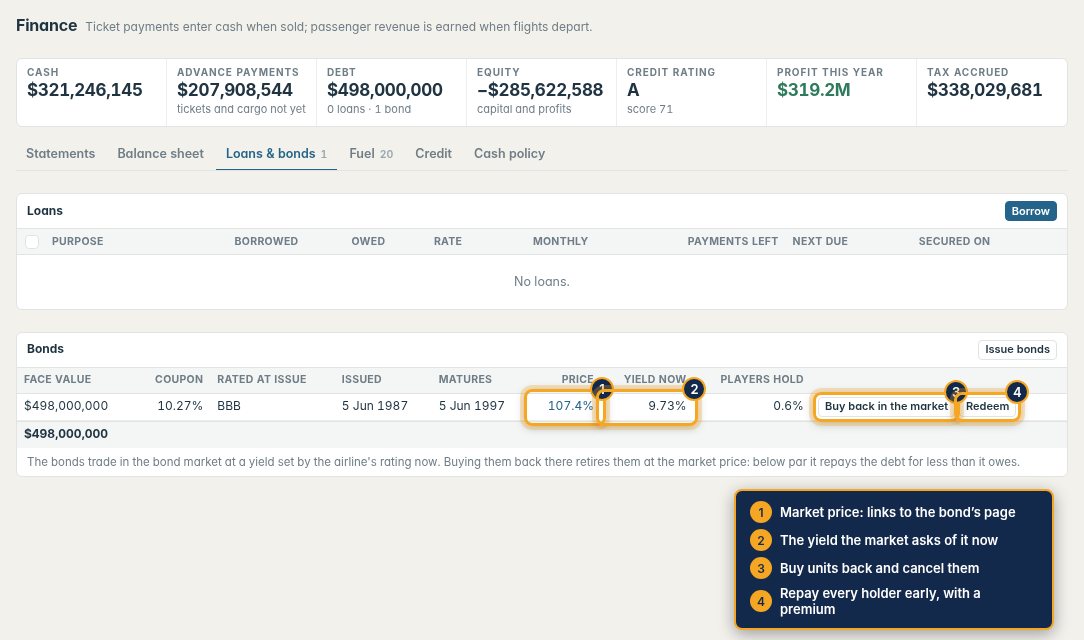
Loans & bonds shows each of your airline's bonds with its market price, the yield the market asks of it now and how much players hold. Buy back in the market buys units from players and outside investors with the airline's cash and cancels them: below face value it clears the debt for less than it owes and ends the coupons on what it buys. Redeem repays every holder the face now, with a call premium, as when rates have fallen enough to borrow again more cheaply.
See also Capital, shares & takeovers and Money & credit.